
What we so fondly call history seems to have been written in water.
Esotericism & History
Rewriting history. In Stone.
When we speak of history, we are not speaking of established facts, but of the image we have of the past. This image is not fixed. If we look closely, we discover that it is not carved in stone, but written in water. History follows the twists and turns of the written word; it is as changeable as language itself. What we so fondly call history has been rewritten time and again. That much is certain. It has been distorted and moulded to suit those in power or those who wrote it down.
We can only trace the roots of Western thought by exploring the realm we have gradually come to call “esotericism”. It was there that humanity began to record, preserve, and systematically develop its ideas about itself and the world. It was there, too, that writing evolved into a crucial part of humanity's collective memory.
Begin at the Beginning. The Origin.
To understand something properly, it is usually best to begin at the beginning. And when it comes to history, that beginning is closely tied to the invention of writing. Everything before the written record, after all, belongs to what we call prehistory.
Writing has become such an ordinary part of everyday life that it is easy to forget that it took more than practical thinking to turn it into something beyond a mere administrative tool. It was in the realm we have gradually come to call “esotericism” that writing became increasingly refined and gained greater expressive power.
Driven by the pursuit of wisdom and a deeply felt desire to understand the world, writing became a means of expressing ever more complex ideas about humanity and the cosmos.
It was here, within esotericism, that poetry and literature emerged, and that, thanks to writing, the first complex conceptions of humanity and the world could be recorded. This brings us close to the beginnings of philosophy and the earliest forms of science.
The temples were not only home to the earliest schools where people learned to write, but also places where important writings were kept “safe” for long periods, under the supposed protection of the gods themselves. Much of humanity's earliest recorded history was therefore written — and stored! — within the confines of esotericism.
To understand the history of the West, Western esotericism is of particular importance.
Isn't this, then, the place to begin?
Western Esotericism. The Missing Thread.
Today, Western esotericism is generally regarded as a late construct, a catch-all for a bewildering variety of traditions, beliefs, and practices. That is why it seems contradictory at first that it is precisely Western esotericism that can bring clarity and coherence.
But the contradiction lies not in esotericism itself, but in the way we have come to understand its history. Somewhere along the way, we seem to have lost the connecting thread, as though it had been cut.
To discover what happened, two cities offer a natural starting point: Athens and Alexandria.
Athens. Alexandria. Ancient Roots.
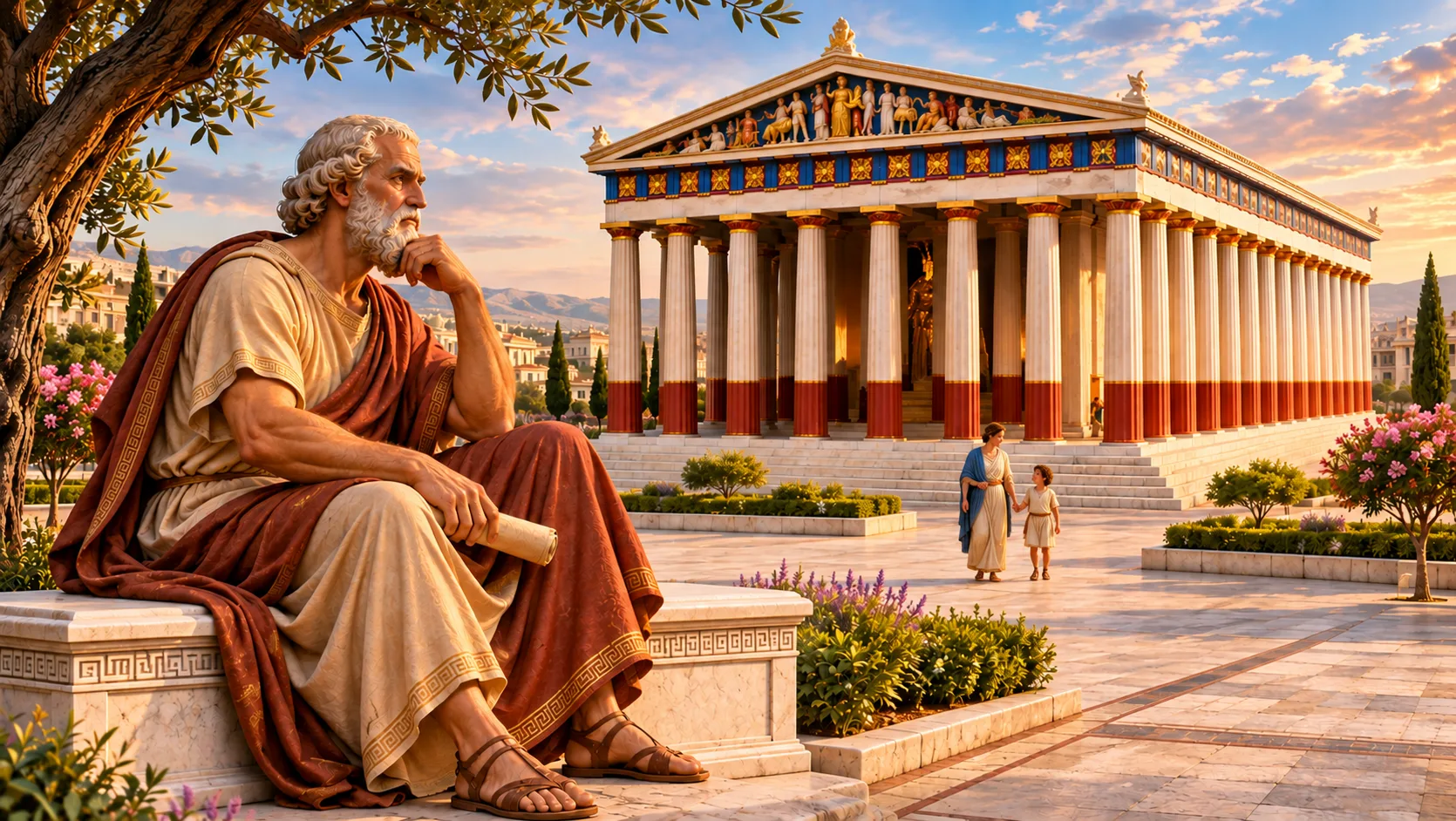
In and around Athens, the ancient mysteries were celebrated as early as the second millennium BCE. The Greeks regarded these mysteries as a unifying force, capable of bringing people together. They also helped create the conditions in which the first democracy could emerge. From the very beginning, philosophy went hand in hand with the mysteries, something we can already recognise in the writings of Plato, founder of the Academy.
In 331 BCE, Alexander the Great founded Alexandria. As the city grew into a cosmopolitan centre of learning and culture, it became a meeting place for different peoples, religions, and traditions. The mysteries found their way there, too, while an organised Hermetic community drew upon teachings that reached back to ancient Egypt.
But Alexandria was far more than a meeting place of Greek and Egyptian wisdom. Its famous library gathered writings from across the known world, and influences from Mesopotamia, Jewish traditions, and even distant parts of Asia found their way into the city. Alexandria became one of the great intellectual crossroads of the ancient world.
It is here, in this extraordinary melting pot, that we first begin to recognise something remarkably similar to what would later be called Western esotericism.
At first glance, the diversity of these traditions may seem overwhelming. Yet a closer look reveals that their differences do not necessarily exclude a common foundation. Beneath the many names, symbols, and expressions, a connecting thread begins to emerge — one that would eventually become known as the Hermetic tradition.
The Hermetic Tradition. A Living Thread.
With the growing power of the Church, much of the knowledge associated with this tradition seems to have disappeared from Europe by the beginning of the sixth century. Only when the power of the Church in Europe began to decline did people once again turn their attention to their ancient roots. But the damage was great. Had Western humanity been uprooted for good?
The Hermetic tradition experienced a remarkable revival, which helped shape the Renaissance itself. In the centuries that followed, the tradition continued to develop through movements such as Rosicrucianism and Freemasonry, and later through Theosophy, Anthroposophy, and the Hermetic Order of the Golden Dawn.
The Hermetic tradition was never a static body of knowledge. It evolved, refined its ideas, and adapted its language to changing times. Yet beneath these transformations, its fundamental principles remained recognisable, connecting later expressions of Western esotericism with Alexandria and, through Alexandria, with the ancient mysteries.
The thread leading back to our roots, it turns out, was never truly broken. It is our understanding of history that has lost sight of it.
Let us return to history as it truly happened.
Further explorations

The Universal Teaching
The Search for Unity
Exploring the underlying patterns that connect esoteric systems.